If you own waterfront property, you face a structural decision that carries significant financial and ecological weight. The line between your land and the water is eroding, literally and figuratively. You need a solution that protects your investment.
The conversation usually starts with two terms: bulkhead and seawall. People often use these words as if they mean the same thing. They do not. The choice between them determines the longevity of your shoreline, the health of the adjacent ecosystem, and the total cost of ownership over the next fifty years.
This guide explains the functional difference, the real world performance data, and the hidden costs associated with each option.
What Is a Bulkhead?
A bulkhead is a vertical retaining structure built along the water’s edge to hold back soil and stabilize waterfront property. Its primary purpose is land retention rather than wave defense.
Bulkheads create a defined boundary between land and water and are commonly installed along canals, residential waterfront lots, marinas, and inland waterways.
How Bulkheads Work
A bulkhead operates on the same principle as any retaining wall. The soil behind it pushes outward with significant force, especially when saturated with water. The bulkhead must resist that pressure without shifting or leaning.
Most bulkheads use deep driven piles that transfer the load into stable soil below. Some rely on their own weight. Others use tieback anchors that extend into the earth behind the wall.
In low energy water, a properly designed bulkhead does not need to manage wave impact. It only needs to hold the bank in place year after year. The structure is simple, proven, and effective for the right conditions.
Common Bulkhead Materials
Each material offers a different balance of cost, lifespan, and performance. The right choice depends on your water conditions and budget.
- Timber: Lowest upfront cost. Traditional material. Susceptible to rot, marine borers, and decay. Lasts 15 to 25 years in freshwater. Less in saltwater.
- Vinyl: Resistant to corrosion and marine organisms. Lighter weight. Easier to install. Moderate lifespan of 20 to 30 years. Limited structural strength for wave zones.
- Concrete Panel: Precast panels between concrete or steel piles. Heavier and more durable than timber. Joints are a weak point under wave stress. Lifespan of 30 to 50 years.
- Steel Sheet Pile: Strongest bulkhead option. Can handle moderate wave energy. Requires corrosion protection in saltwater. Lifespan of 40 to 60 years.
Where Bulkheads Are Typically Installed
Bulkheads belong in low energy environments where wave action is minimal. Calm canals, protected marinas, small freshwater lakes, and slow moving rivers are ideal locations. The primary threat at these sites is soil erosion from water contact and gravity, not from wave attack.
Boat wakes may produce the largest waves the structure ever sees. A bulkhead installed in these conditions will perform reliably for decades. Many residential waterfront lots use bulkheads to maintain a clean property line and prevent the yard from slumping into the water.
What Is a Seawall?
A seawall is a shoreline protection structure specifically engineered to defend coastal property against wave energy, storm surge, erosion, and flooding.
Unlike bulkheads, seawalls are designed to withstand direct impacts from waves and coastal forces.
Seawalls are often larger, stronger, and more heavily reinforced than bulkheads because they serve as a first line of defense against the ocean.
How Seawalls Protect Shorelines
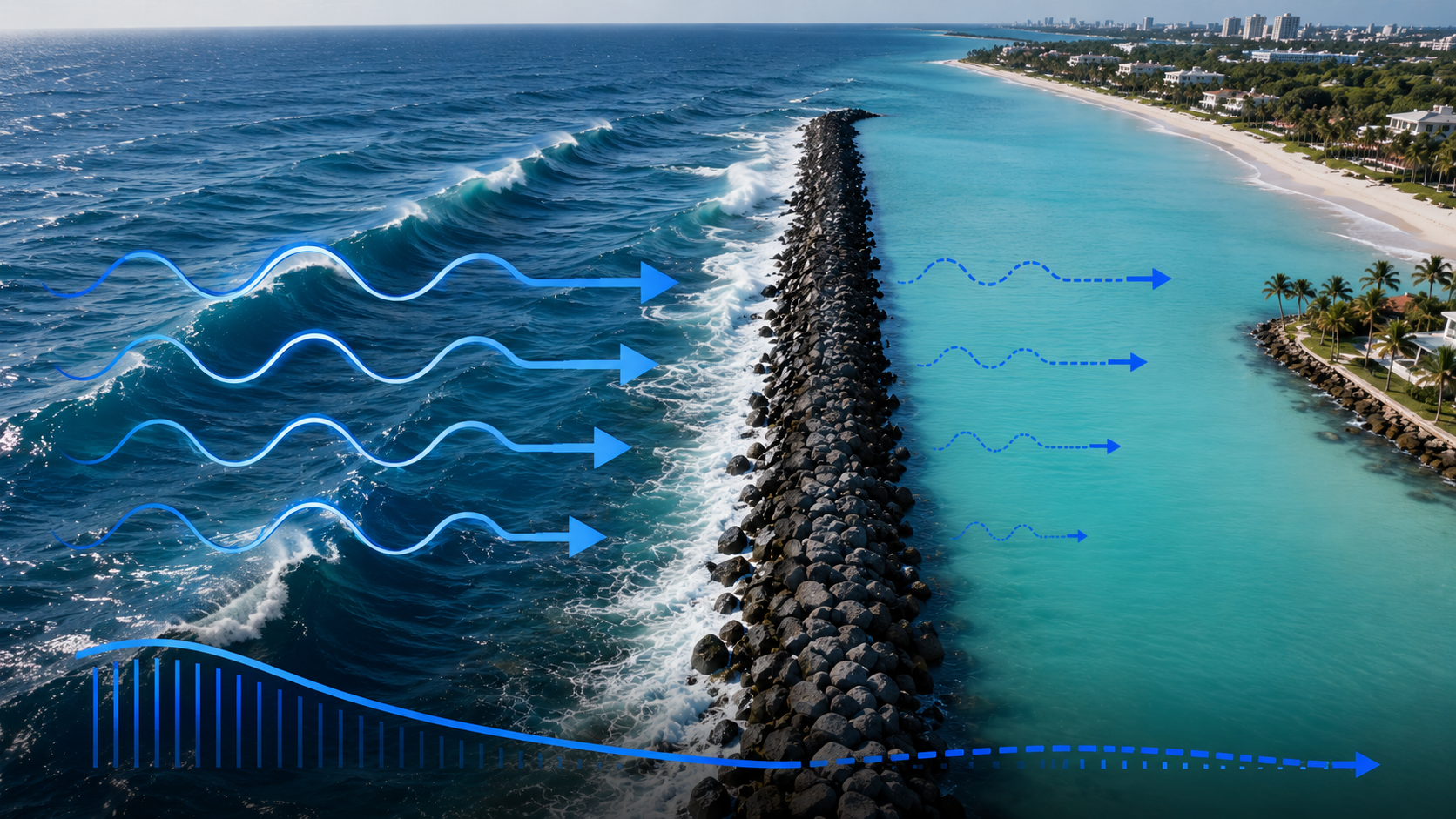
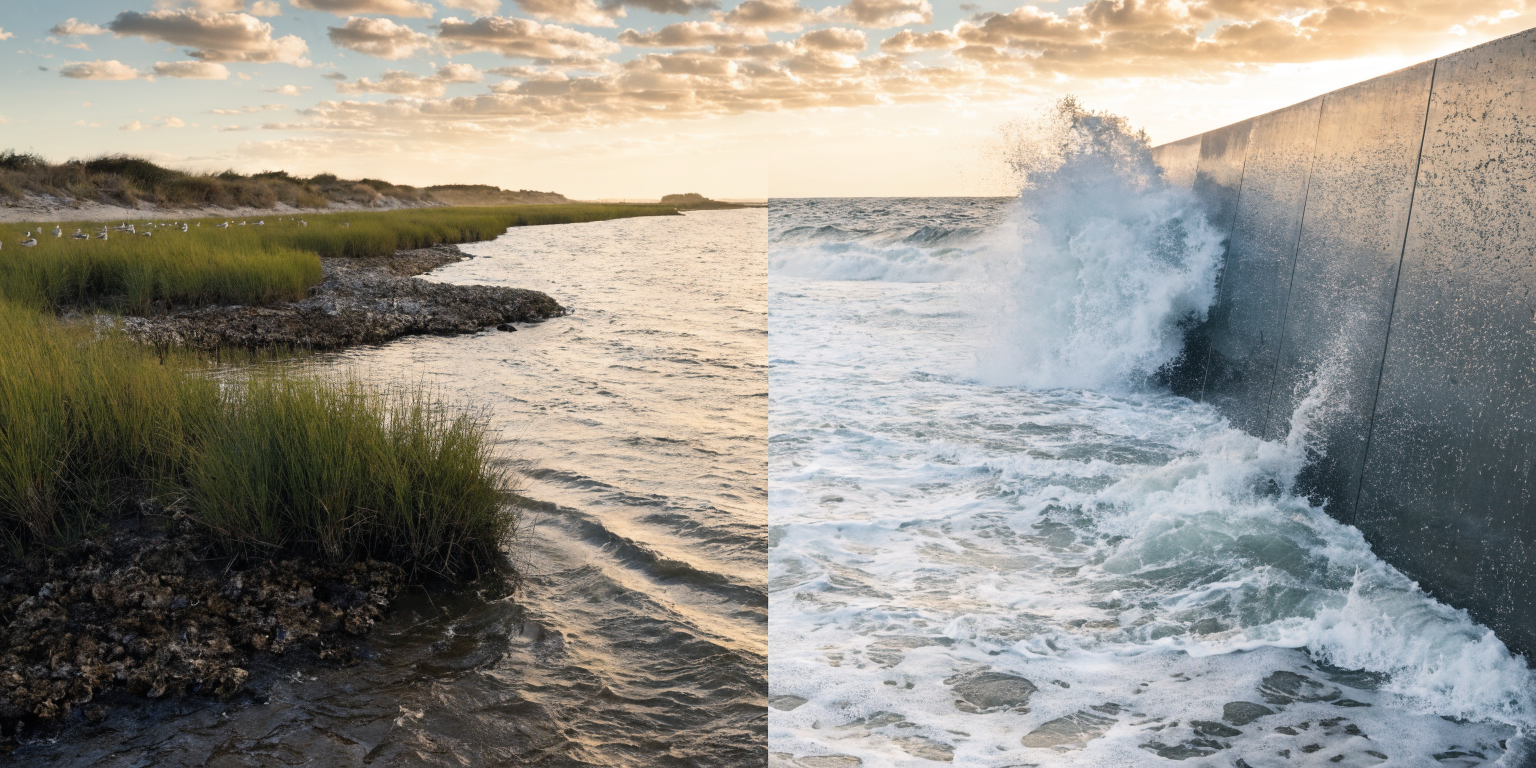
Seawalls serve as the first line of defense against incoming wave energy. When a wave hits a vertical seawall, the energy is reflected back toward open water.
This protects the land behind the wall but can also create problems. The reflected energy scours the seabed at the base of the wall, which can undermine the structure over time.
More advanced seawall designs use curved or stepped faces. These shapes force waves to break before reaching the wall, dissipating energy and reducing scour.
A seawall must also resist lateral earth pressure from the soil behind it, similar to a bulkhead. But the added requirement of wave resistance makes seawalls fundamentally different in design and cost.
Common Seawall Construction Materials
Seawall materials are chosen for strength and durability under constant wave attack. Each option has specific advantages depending on site conditions. Seawall construction methods vary by material.
- Poured Reinforced Concrete: The gold standard for durability. Can be shaped into curved or textured profiles for better wave dissipation. Lifespan of 50 to 100 years. High upfront cost.
- Steel Sheet Pile: Extremely strong. Driven deep into the substrate. Good for tight spaces. Corrosion protection is critical in saltwater. Lifespan of 40 to 60 years.
- Stone Rip Rap: Sloping layer of large rock. Dissipates wave energy effectively. Requires a wide footprint. Not suitable for narrow lots. Lifespan of 30 to 50 years.
- Concrete Block or Mat Systems: Interlocking units with some flexibility. Easier to install than poured concrete. Good performance in moderate wave conditions.
Where Seawalls Are Most Effective
Seawalls are required wherever wave action poses a threat to property. Oceanfront lots are the most obvious example. The Great Lakes also produce waves that can destroy a bulkhead. Wide bays, large reservoirs, and exposed river mouths all fall into this category.
A simple rule helps property owners assess their situation. If you can see more than a mile of open water in any direction, you are in seawall territory. Seawalls are also the right choice when high value assets sit close to the shoreline.
A house, a road, or critical infrastructure demands the protection that only a seawall can provide. If you notice signs of seawall failure such as cracking, leaning, or scour, professional evaluation is needed immediately.
Bulkheads vs Seawalls: Key Differences
Understanding the key differences between these two structures prevents costly mistakes. The choice is not about preference. It is about matching the structure to the site conditions.
Primary Purpose and Function
The purpose of a bulkhead is soil retention. The purpose of a seawall is wave defense. This single distinction drives every other difference in design, cost, and performance.
A bulkhead holds the land in place. A seawall holds the water back. When property owners confuse these functions, they end up with a structure that cannot handle the conditions it faces.
Structural Design Differences
Bulkheads are designed for lateral earth pressure. The soil behind the wall pushes outward, and the bulkhead resists that force.
The design is straightforward. Seawalls must handle everything a bulkhead handles plus dynamic wave loads, uplift forces, and scour at the base. This requires deeper foundations, stronger materials, and more sophisticated engineering.
Wave Protection Capabilities
Bulkheads offer almost no wave protection. When a wave hits a bulkhead, the energy overtops the wall, scours the base, and accelerates failure. Seawalls are designed for this exact purpose.
A properly engineered seawall can reduce wave energy reaching the shoreline by 50 to 80 percent. Curved, stepped, and textured seawalls perform better than vertical walls because they dissipate energy rather than reflecting it.
This is one reason why best shoreline protection for waterfront homes increasingly favors advanced seawall designs.
Soil Retention Performance
Both structures hold soil, but they do it in different contexts. A bulkhead focuses entirely on soil retention in low energy environments. A seawall retains soil while simultaneously resisting wave attack.
The seawall requires a more robust connection between the wall and the soil. Filter fabric, stone backfill, and proper drainage prevent soil from washing out through joints or gaps.
Installation Requirements
Bulkhead installation is simpler and faster. Excavation is shallower. Materials are lighter. A crew with basic equipment can install a timber or vinyl bulkhead in days.
Seawall installation requires heavy machinery, deep excavation or pile driving, and often dewatering systems. Engineering oversight is essential. Permitting is more complex.
Visual Appearance and Property Impact
Bulkheads sit lower to the waterline and are often partially hidden by vegetation. Seawalls are taller and more prominent. However, modern designs address this concern. Textured surfaces, stepped profiles, and Living Seawall™ technology improve appearance while adding ecological value.
A Living Seawall supports marine growth that softens the visual edge and integrates the structure into the natural environment. This approach represents a shift from traditional hardened shorelines toward eco engineered shoreline structures.
When a Bulkhead Is the Better Choice
Not every waterfront requires a seawall. For many properties, a bulkhead is the correct and most cost effective solution for shoreline stabilization and waterfront erosion control. Here are the specific conditions where a bulkhead makes sense.
Low Energy Shorelines
Low energy shorelines do not experience significant wave action. Small lakes, protected coves, and slow moving rivers fall into this category.
A bulkhead performs perfectly in these conditions. The wall holds the soil, prevents erosion, and maintains the property boundary. There is no reason to spend more for a seawall when a bulkhead will do the job for decades.
Canals, Marinas, and Inland Waterways
Canals are some of the most common locations for bulkheads. The water is confined and waves are small. Marinas also use bulkheads extensively.
Inland waterways that do not connect to large bodies of open water are ideal for bulkheads. These environments are predictable and low stress.
Retaining Soil Along Waterfront Properties
Many waterfront properties are losing soil to the water inch by inch. The bank slumps. The lawn shrinks. A bulkhead solves this problem directly. It holds the soil in place and prevents further loss.
For property owners whose main concern is keeping their yard intact, a bulkhead is the right tool. Marine erosion control at this level does not require a seawall.
Projects With Limited Budgets
Cost is a real constraint. Bulkheads cost less than seawalls. A timber bulkhead can be installed for a fraction of the cost of a concrete seawall.
For property owners who need functional erosion control without taking on major debt, a bulkhead is the practical choice.
When a Seawall Is the Better Choice
Some properties demand the strength of a seawall. Attempting to use a bulkhead in these conditions leads to failure, repair costs, and potential property damage. Here is when a seawall is the right call.
Properties Exposed to Strong Wave Action
If waves regularly hit your shoreline, you need a seawall. A bulkhead will not survive. The wave energy will force its way through joints, scour the base, and push the wall over.
A seawall is designed for this exact condition. The upfront cost is higher, but it is the only option that provides reliable long term coastal erosion protection.
Coastal Areas Prone to Storm Damage
Storm surge is a worst case scenario for any shoreline structure. Properties in hurricane zones, nor’easter zones, or areas with frequent severe weather require a seawall.
The seawall must be designed for the expected storm conditions. Overtopping, scour, and debris impact are all factored into the design.
Long Term Shoreline Protection Needs
Some property owners want a solution that outlasts them. A seawall is a generational investment. A poured concrete seawall can last 50 to 100 years.
For families who plan to hold the property long term, the higher upfront cost pays for itself over time.
Protecting Buildings and Infrastructure
When a house sits close to the shoreline, the stakes are high. The same applies to roads, utilities, and commercial buildings. The cost of a seawall is justified by the value of the asset it protects.
In these situations, the seawall is insurance against catastrophic loss. A shoreline protection system designed for high value assets must account for worst case scenarios.
Bulkhead vs Seawall Lifespan & Cost
The lifespan of your shoreline structure determines your total cost of ownership. A cheap wall that fails in 20 years may cost more than an expensive wall that lasts 75 years.
When comparing bulkhead or seawall for waterfront property, long term cost matters as much as upfront price.
Expected Lifespan of a Bulkhead
Lifespan varies dramatically by material and environment.
- Timber: 15 to 25 years in freshwater, 10 to 15 years in saltwater
- Vinyl: 20 to 30 years
- Concrete Panel: 30 to 50 years
- Steel Sheet Pile: 40 to 60 years with proper corrosion protection
Expected Lifespan of a Seawall
Seawalls offer significantly longer service life.
- Poured Concrete: 50 to 100 years
- Steel Sheet Pile: 40 to 60 years
- Stone Rip Rap: 30 to 50 years before requiring maintenance
Factors That Influence Service Life
Environmental conditions and construction quality both affect how long your structure lasts.
- Water salinity: Saltwater accelerates corrosion and decay
- Ice action: Freeze thaw cycles damage surfaces and joints
- Storm events: Major storms cause immediate structural stress
- Construction quality: Poor installation reduces lifespan significantly
- Maintenance: Regular inspection and prompt repairs extend service life
Factors That Affect Project Pricing
Cost is often the deciding factor for property owners. But the upfront price is only part of the equation.
The cost to replace a seawall is significantly higher than initial installation, which is why choosing the right structure the first time matters.
- Site accessibility: Remote or difficult to reach locations increase mobilization costs
- Soil conditions: Sandy or unstable soils require deeper foundations
- Water depth: Deeper water requires taller walls and more material
- Dewatering: Keeping the work area dry adds time and expense
- Permitting fees: Vary by jurisdiction and project complexity
- Engineering design: Typically adds 5 to 15 percent to total project cost
Environmental and Permitting Considerations
The environmental impact of your shoreline structure affects more than the local ecosystem. It determines how quickly you get a permit and whether your project is approved.
Seawall repair and replacement projects are increasingly subject to stricter environmental review.
Traditional Seawall
Traditional seawalls often protect property at the expense of marine habitat. Smooth concrete surfaces provide little ecological value and can increase localized scour.
Newer Living Seawall systems are designed to protect shorelines while creating habitat for oysters, barnacles, fish, and other marine species.
Permit Requirements for Waterfront Construction
Any construction below the high water mark requires permits. Federal agencies such as the Army Corps of Engineers have jurisdiction over navigable waters. State environmental agencies add their own requirements.
Local governments often have additional shoreline protection ordinances. The permit process can take three to twelve months. Starting early is essential.
Environmental Impact Considerations
Traditional bulkheads and seawalls have a negative environmental impact. They eliminate the intertidal zone where aquatic life feeds and reproduces. They create a sterile vertical wall that supports minimal biological activity.
Many regulatory agencies now require mitigation measures for new construction or replacement projects. Choosing a Living Seawall changes the permitting conversation entirely because the project provides net environmental benefit rather than net harm.
Working With a Marine Construction Contractor
Choosing the right contractor is as important as choosing the right structure. Marine construction requires specialized knowledge that general contractors do not have. The contractor must understand tidal cycles, scour, soil mechanics, and regulatory compliance.
Ask for references and case studies. Verify licenses and insurance. A qualified seawall contractor will guide you through the permitting process and ensure proper installation.
How to Choose Between a Bulkhead and a Seawall
There is no universal best option. Your choice depends entirely on the energy level, soil, and flood risk of your specific site. When considering shoreline protection options, work through these criteria.
| Choose a Bulkhead if… | Choose a Seawall if… |
| Your property is on a lake, canal, or sheltered river with minimal waves | Your property faces an ocean, open bay, or large lake with significant fetch |
| Your primary goal is shoreline stabilization keeping soil in place | Your primary goal is flood protection and defense against storm surge |
| Your budget is more constrained and you can commit to regular maintenance | You need a long-term, heavy-duty solution for a high-value property |
| The land behind the wall is not at immediate risk from storm surge flooding | You are prepared for a high capital investment and strict permitting |
| You want simpler permitting and faster construction timelines | You want 50+ years of protection without frequent replacement |
Conclusion
Every waterfront property has different wave exposure, soil conditions, and permitting requirements. A professional shoreline assessment can identify the safest and most cost effective solution before construction begins.
For properties that need a seawall, the choice between a traditional wall and a Living Seawall™ determines not just your property’s protection but its ecological impact and regulatory path.
Speak with an experienced seawall contractor like Kind Designs to review your site and compare bulkhead and seawall options.
Frequently Asked Questions
These are the most common questions property owners ask when choosing between a bulkhead and a seawall. The answers provide a quick reference for your decision making process.
What Is the Difference Between a Bulkhead and a Seawall?
A bulkhead retains soil. A seawall stops waves. A bulkhead is for low energy environments. A seawall is for sites exposed to wave action. Every other difference follows from this fundamental distinction.
Is a Bulkhead Cheaper Than a Seawall?
Yes, in most cases. Bulkheads cost $150 to $600 per linear foot depending on material. Seawalls cost $400 to $1,500 per linear foot. However, a bulkhead installed in the wrong location will fail and cost more to replace than a seawall would have cost initially.
Which Lasts Longer, a Bulkhead or a Seawall?
Seawalls last longer. A poured concrete seawall can last 50 to 100 years. A timber bulkhead lasts 15 to 25 years. Steel sheet pile bulkheads last longer than timber but still fall short of concrete seawalls.
Which Is Better for Erosion Control, a Bulkhead or a Seawall?
Both control erosion in their appropriate contexts. A bulkhead controls soil erosion in low energy water. A seawall controls erosion from wave action in high energy environments. The better choice depends entirely on your site conditions.
Can a Bulkhead Be Replaced With a Seawall?
Yes, but it is a major project. The existing bulkhead must be removed. Deeper excavation is required. Permitting is more extensive. The cost is significantly higher than a simple bulkhead replacement. The upgrade is worth it if your site requires the additional protection that only a seawall can provide.