Dr. James Fourqurean, Dr. Alain Duran, PhD candidate Emily Jackson
Measuring the Ecological Impact of Living Seawalls™
Kind Designs partnered with Florida International University (FIU) to conduct a year-long ecological monitoring study of our Living Seawalls™ in Biscayne Bay, led by Dr. Alastair Harborne, Emily Jackson and Danielle Cox at FIU’s Tropical Fish Ecology Lab. The study evaluates how marine communities—fish, algae, invertebrates, and filter feeders—develop on our 3D-printed Living Seawalls™ compared to adjacent conventional seawalls.
This collaboration provides scientific data on how Living Seawalls™ support biodiversity, enhance water quality, and contribute to long-term ecological resilience in urban coastal environments. This research is part of a broader effort to redefine coastal infrastructure as living systems that restore marine habitats while protecting shorelines.
After nine surveys, at three sites, over 12 months, FIU scientists documented 91 unique marine organisms living on, in, or around our Living Seawalls™ and found that every biodiversity metric they tracked rose significantly with time since installation (The true number of actual species is higher since researchers classified algae by type and ecological role, rather than to species level because of the challenges of algal taxonomy).
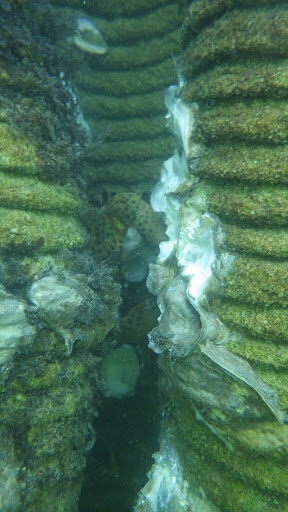
Stone Crab observed in a mangrove-root cavity offering structural refuge from predators (Oct ’25). Oysters and algae are also pictured.
Research Objectives
Evaluating Biodiversity, Habitat Formation, and Carbon Sequestration
The FIU monitoring program is designed to:
Quantify biodiversity improvements created by Living Seawall™ installations
Benchmark Living Seawalls™ directly against neighboring traditional seawalls surveyed on the same day with the same methods.
Track ecological succession, including colonization by algae, invertebrates, and fishes.
Assess carbon storage potential through accumulation of organic material and calcareous organisms.
Inform future seawall designs by identifying textures and geometries that best promote ecosystem growth.
Methodology
Integrated Field Surveys and Carbon Sampling by FIU Marine Scientists
Study Sites: Four coastal zones: 3 in Biscayne Bay & 1 on the New River in Fort Lauderdale . Each site varies in the salinity gradient, from roughly 26 ppt in the bay down to 3 ppt at the surface in Fort Lauderdale, allowing FIU to test how Living Seawalls™ perform across different coastal conditions.
Survey Schedule:
Monthly diver surveys for the first six months, followed by bimonthly surveys through 12 months.
All fieldwork conducted between 11:00–14:00, around high tide for data consistency.
Survey Components:
Fish Assemblages:
Roving snorkel surveys along Living Seawalls™ and adjacent control walls (20 minutes, two snorkelers).
Unbaited GoPro 12 cameras (two per wall, 60-minute deployments) recorded fish species that avoid divers.
Fish lengths were recorded to the nearest half-centimetre and converted to biomass using published length-weight coefficients, allowing FIU to track how much biomass the walls supported.
Benthic Community Development:
Video quadrants (0.25 m2, with 6 to 7 completed per wall) document the face of each structure. Images were color-corrected using Darktable software and analyzed using Coral Point Count, documenting colonization of algae, invertebrates, and sessile organisms.
Videos analyzed to determine percentage cover of each benthic taxon.
Carbon Analyses:
Sentinel tiles (10 cm × 10 cm) made from the same 3D-printed material were installed to measure organic carbon accumulation and carbonate formation.
Sediment cores collected at the base of the seawalls to track changes in sedimentary carbon storage.
This integrated monitoring framework evaluates biodiversity succession, fish community use, and carbon sequestration on Living Seawall structures, while providing comparative data against adjacent conventional seawalls.
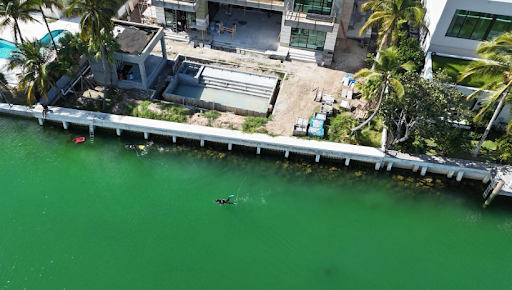
Dr. Harborne diving at N Bay rd, Miami Beach Living Seawall installation
Key Findings
Early Ecological Indicators of Success
Across all monitoring sites, Kind Designs’ Living Seawalls™ demonstrated clear and rapid ecological response— showing an accumulation of benthic and fish biodiversity over the course of a 12-month monitoring period– and outperforming neighboring traditional walls with riprap in front.
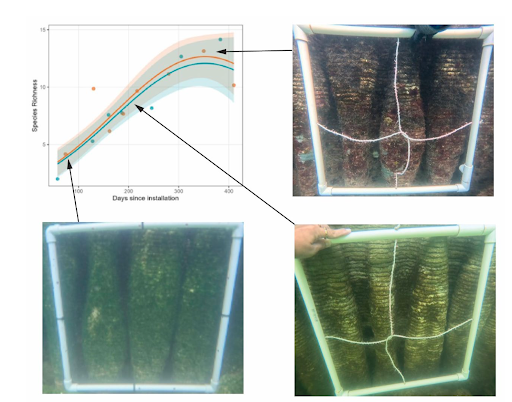
➟ Rapid Colonization: Life established progressively across multiple trophic levels. Benthic metrics increased dramatically with time, showing a steep successional rate of increase before leveling off to a mature asymptote at approximately day 300. Within just 6 months of installation, the new walls at Venetian Way and North Bay Road achieved survey instances with more observed fish species than older neighboring seawalls with riprap in place for twice as long.
➟ Enhanced Biodiversity: Living Seawalls™ supported a significantly higher diversity of marine life than adjacent flat concrete walls. Across the study, 36 distinct benthic taxa and 30 fish species were recorded during the formal surveys. This included vital early recruitment of soft corals (such as Carijoa riisei), branching anemones (Lebrunia neglecta), and a variety of crustose coralline algae, which are strong precursors for future hard coral settlement. Barracuda, snapper, and other predators were also seen more often as time since installation increased, which is a sign that the Living Seawalls are supporting complex food webs.
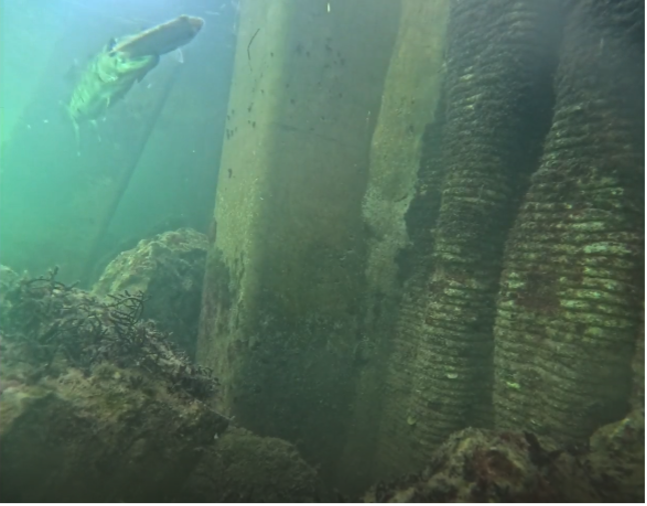
Barracuda predating on a yellowfin mojarra. Occured at the Venetian wall in January 2026
“We have also witnessed predator-prey interactions among fish at the walls, suggesting the establishment of a functioning assemblage… Further, we have direct observation of a predation event in which a subadult barracuda successfully hunted and captured a juvenile yellowfin mojarra directly adjacent to the wall, showing that the seawalls support sufficient prey to attract higher trophic level predators. Additionally, observed behaviors such as mouth gape fighting by grunts and grazing by parrotfish suggest that fish are recognizing the Living Seawalls as functioning habitat and not just passing through during the surveys.” – FIU Final Report 2026
➟ Functional Habitat: The undulating “mangrove root” folds and deep surface textures provided microhabitats for shelter, foraging, and nursery refuge absent on flat structures. Mobile invertebrates like stone crabs (Menippe mercenaria) and rock-boring urchins (Echinometra lucunter), along with dense layers of primary producers, like turf algae, and filter feeders formed a highly localized feeding zone.
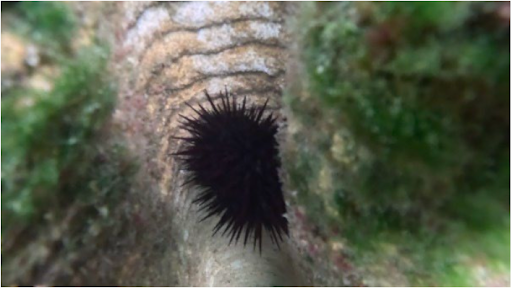
An urchin (Echinometra lucunter) sheltering in a Living Seawall™ cave, which provides protected habitat. March ‘25
Figure showing the increasing benthic biodiversity of Living Seawalls over 12 months since installation. The top left panel shows the data and the statistically fitted curve of days since wall installation against species richness (number of organism types or species seen at each time point, North Bay in orange, Venetian in blue). The pictures show the changing species soon after installation (bottom left, dominated by turf algae), approximately 6 months after installation (bottom right, a mixed assemblage of algae and some small invertebrates), and at the end of the surveys (top right, a mature mix of algae and invertebrates).
Living Seawalls function as a true, complete ecosystem rather than a passive structure. These observations confirm that the biomimetic design of Living Seawalls™ not only restores habitat complexity but also accelerates the return of ecological function to hardened urban shorelines.
Fig. 1 Within this small section of the Living Seawall, organisms from multiple trophic levels coexist, demonstrating how complex surface textures & designs create miniature ecosystems that support an entire food web.
Fig. 1 & 2: Octocoral, anemones, macroalgae (including crustose coralline algae), and sponges encrusting the “mangrove root” space of the Venetian seawall. November 2025
Fig. 3. School of Mullet observed congregating near the Living Seawall™ in Oct ’25, where colonization by algae and invertebrates have created a localized feeding zone.
Fig. 4. Wall algal assemblage at North Bay Rd, dominated by turf algae, an important food source for grazing fish species.
Fig. 5. Riprap quadrats at North Bay, dominated by thick corticated and filamentous algae species, not typically consumed by grazing fishes. October 2025
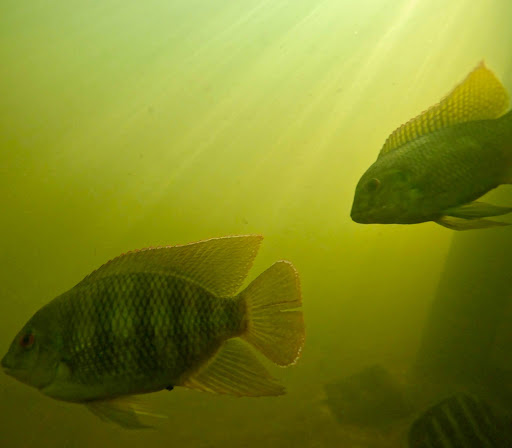
Fig 6. A school of tilapia using the Living Seawall™ as a foraging and shelter zone in Ft. Lauderdale— a sign of early multi-trophic engagement as fish respond to the growing community of algae and invertebrates. Oct 13th ‘25
Practical Applications
Natural Hardscapes That Improve Water Quality and Resilience
Living Seawalls™ function as self-mitigating systems that restore ecological processes while providing durable coastal protection.
The biological communities that form on our seawalls enhance carbon sequestration, nutrient cycling, and habitat availability—critical ecosystem functions absent in traditional seawalls. Filter feeders actively improve water clarity by removing suspended particles from the water column. EX. 1 oysters can filter up to 200 liters of water per day.
By month thirteen, roughly a third of the surface of our North Bay Living Seawall™ was covered by filter-feeding organisms–barnacles, sponges, and oysters–and FIU’s models show filter-feeder cover rising significantly and continuously across the whole monitoring period. The traditional, flat seawall next door recorded no sponges or tunicates at all.
By supporting the entire coastal food web—from primary producers to top predators—Living Seawalls™ transform built shorelines into thriving, self-sustaining ecosystems that improve water quality, enhance biodiversity, and strengthen community resilience.
Ongoing Research
Long-Term Monitoring and Design Refinement
FIU’s research provides a foundation for multi-year ecological monitoring and design optimization. Findings from Biscayne Bay are informing the next generation of Living Seawalls™ – Kind Designs continues to collaborate with research institutions to refine textures, materials, and geometries that maximize biodiversity, resilience, and water quality benefits. We’re expanding our biomimicry research to develop next-generation Living Seawalls™ inspired by native coastal habitats across the nation to maximize both biodiversity and resilience.
Our mission: to transform coastal infrastructure into living, regenerative systems that protect both people and the planet.
A school of tilapia using the Living Seawall™ as a foraging and shelter zone in Ft. Lauderdale— a sign of early multi-trophic engagement as fish respond to the growing community of algae and invertebrates. Oct 13th ‘25
Ask us anything
Complete this form and our team will be in touch shortly to answer any questions!