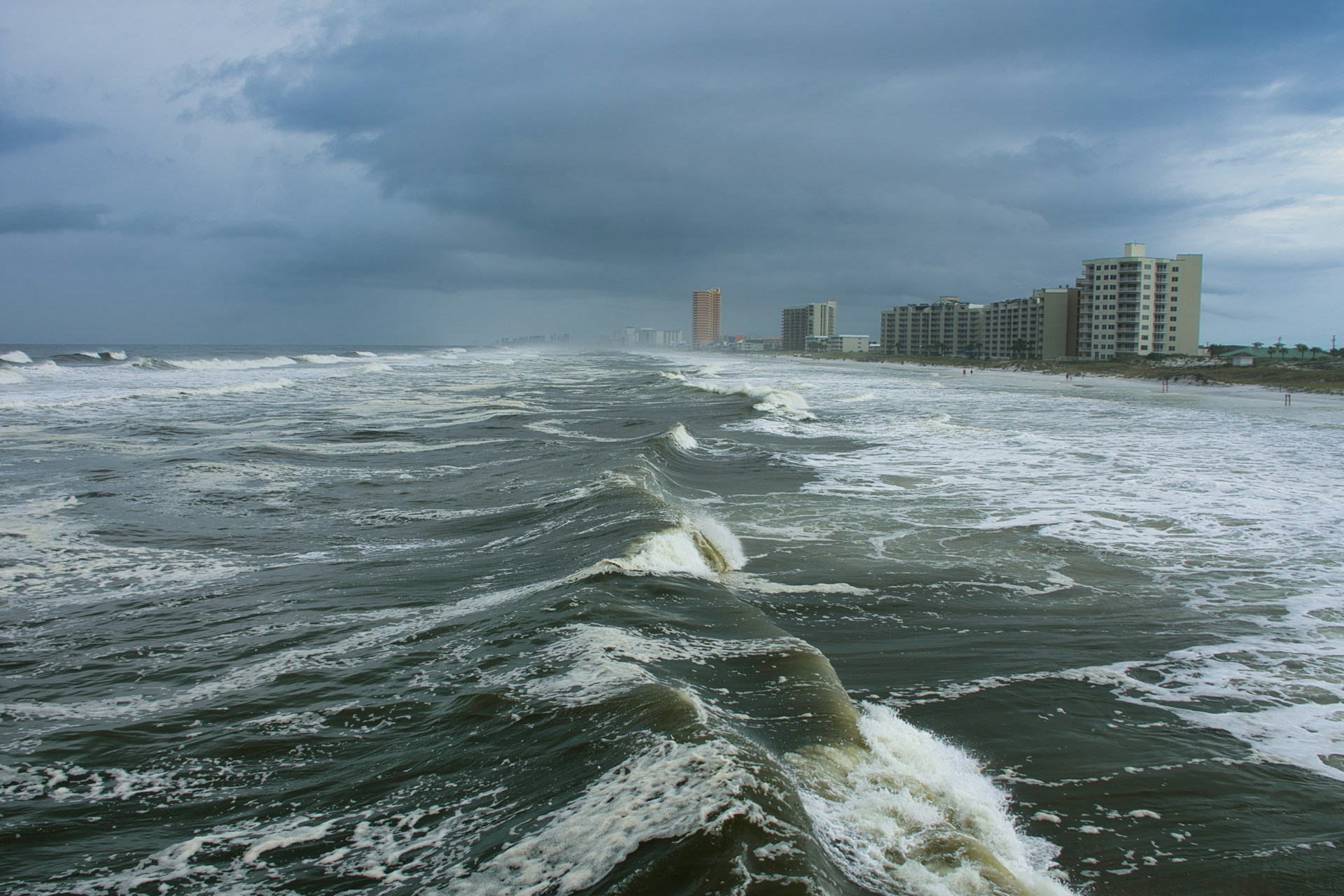
Hurricane season puts every waterfront wall through a test that it never sees the rest of the year. The test has three parts: a rising sea, waves,, and soil that turns soft behind the wall. Most owners watch the wind speed. Storm surge is the abnormal rise of water pushed toward shore by a storm’s winds. The National Hurricane Center calls it the leading cause of hurricane-related deaths in the United States. It is also the first force that meets your wall. Any wall on the water spends only a few hours a year doing its real job. Hurricane season is when that job turns violent.
Hurricane Ian showed what that means in concrete terms. The storm hit southwestern Florida in 2022 as a Category 4 hurricane. NOAA’s post-storm report placed peak surge inundation at 12 to 18 feet along parts of the coast. The full tropical cyclone report documents the damage in detail. A post-storm assessment along the Punta Gorda canals found nearly 600 properties with seawall damage. Some of those failures were rated near catastrophic.
What the Rising Water Does to the Seawall
Surge does not hit a wall like a wave. It acts more like a rising lake that pushes steadily against the seawall. That constant push is hydrostatic pressure, and it grows with depth. Raise the water 20%and the total force on the wall grows by roughly 44%. The pressure rises with depth, and the wet area grows at the same time. In simple terms, a storm that raises the water a little raises the load a lot.
Many Miami seawalls were built when the waterline sat lower. Sea levels have been climbing since, and NOAA’s sea level rise research tracks where that matters most. A wall that cleared the tide by two feet fifty years ago may clear it by inches today. The same wall now faces surge that starts from a higher floor. Old design standards are not a criticism of the wall. They are a reason to measure the cap height against today’s water, not the water your grandfather saw.
What the Waves Add on Top
Waves are where the wall earns its scars. A breaking wave slams the face with a sudden load. That impulsive punch can be many times greater than the surge’s steady push. Waves also run up the face and fall back, and each fall drags material away from the base.
Vertical walls reflect energy rather than absorb it. A flat face sends much of the wave back out toward the channel. That reflected energy digs at the base of the wall. Research on wave driven scour names it one of the major causes of seawall failure.
When surge and waves together pass the top of the wall, the water goes over. Overtopping looks dramatic, but the real damage is behind the wall. Each gallon that pours over carries soil with it when it drains back. A lawn that sinks after a storm is usually the receipt for an overtopped wall.
What the Rain Does From the Land Side
People forget that a hurricane is days of rain on the land side of the wall. The fill behind a seawall is mostly sand and soil, and rain saturates it like a sponge. Saturated soil is heavier and weaker, and it pushes against the wall’s back. Add the tide pushing from the front and the wall is pinched between two loads.
Drainage is the pressure release valve. Weep holes and outfall pipes let water escape before it builds up. When they clog, the pressure stays, and the wall carries a load it was never designed to hold. That is why a blocked weep hole is a warning sign worth chasing in May.
Why Time Makes It Worse
A hurricane is not a single slam. The surge holds the water high for hours while waves keep hitting the wet face of the seawall. A seawall can bear a steady load for twelve hours. It can fail in the eleventh hour, when the soil behind it finally gives. Add saltwater to the equation and every hour of exposure drives corrosion a little deeper into steel and rebar. The damage is not one event. It is a process that runs as long as the storm does.
The Sequence That Kills a Seawall
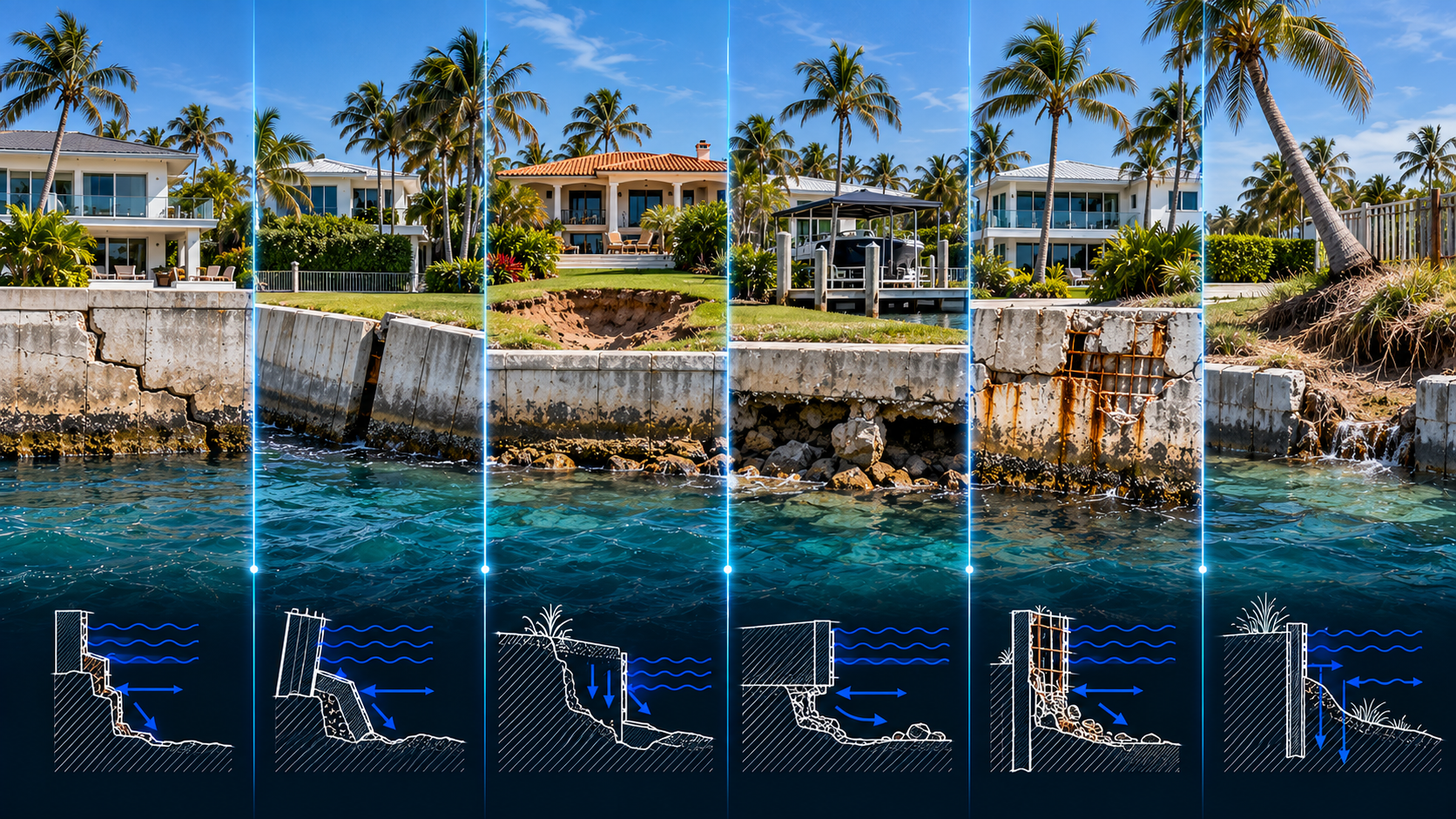
Steel seawalls corrode and concrete seawalls crack, but both fail the same way. They move. The usual sequence runs in a clear order. Scour removes the toe support, the wall rotates, cracks open, and soil washes out behind it. Each step loads the next one. A seawall is only as strong as its tiebacks and the soil they grip. That is why understanding how a seawall is built helps you read the damage.
Around Miami and South Florida we see the same pattern after every big storm. Toe scour on the channel side, then a tilt, then a yard that starts to sink. The owners who act in the first months after the storm get the cheapest fix. Those who wait a season get the repair-or-replace conversation at full price.
Why Some Seawalls Come Through Fine
The seawalls that survive a hurricane season share specific features. Their caps sit high enough to shed most overtopping. Their tiebacks are sound, their drainage works, and their toes are protected from scour. None of that is exotic engineering. It is the design guidance the Army Corps of Engineers publishes for seawalls and bulkheads, applied honestly to the site.
Energy also matters. A seawall wetface that absorbs wave energy instead of throwing it back keeps the toe and the neighbor’s yard in better shape. A living seawall does exactly that, with a textured surface that breaks waves while marine life settles on it.
Debris is the wild card no design fully removes. Boats break loose, docks tear free, and floating timber hits the wall with the surge behind it. The loose dock that becomes a battering ram during surge is a warning sign we push owners to fix before June.
What Owners Get Wrong Before the Storm
It is easy to misread a seawall’s odds. Hurricane category is what most owners quote. Your house’s surge depends on the storm’s size, speed, and angle, plus the tide it hits. A slow Category 2 can push more water against your wall than a fast Category 4 that passes far offshore. The number on the news is not the number at your waterline.
Owners also assume the seawall either works or collapses. Most seawalls fail in degrees. They rotate an inch, lose toe protection, or swallow some backfill, and the defense quietly dies while the house stays standing.
The last mistake is timing. Seawalls get judged in the calm months for a reason. Problems found before a storm are cheap, and problems found after it are expensive. The post-storm line at every contractor in Florida proves it.
The Walk You Take After Landfall
The storm is not the end of the test. The days after landfall are when the damage shows up. Walk the seawall within the first week. Look for new cracks, a fresh lean, seepage through the joints, and low spots in the yard. Check the dock pilings and the caps. Photograph everything, because insurance claims live and die on documentation. Note any damage you already knew about, because adjusters will ask what was there before.
Then run the same walk from our 12 warning signs checklist one more time. A storm finds what spring missed. A crack that was cosmetic in May can be structural in September. If the yard has dropped even a few inches, the wall has lost its grip on something.
Hurricane season does not decide whether your wall gets a test. It only decides the severity. The walls that fail have an undiagnosed problem the day the water arrives. Talk to the Kind Designs team before the next named storm. They read the wall, the soil, and the water together. Their living seawalls hold the line while giving the bay back habitat. Estimate the project with the seawall cost calculator, then walk your property with the team.