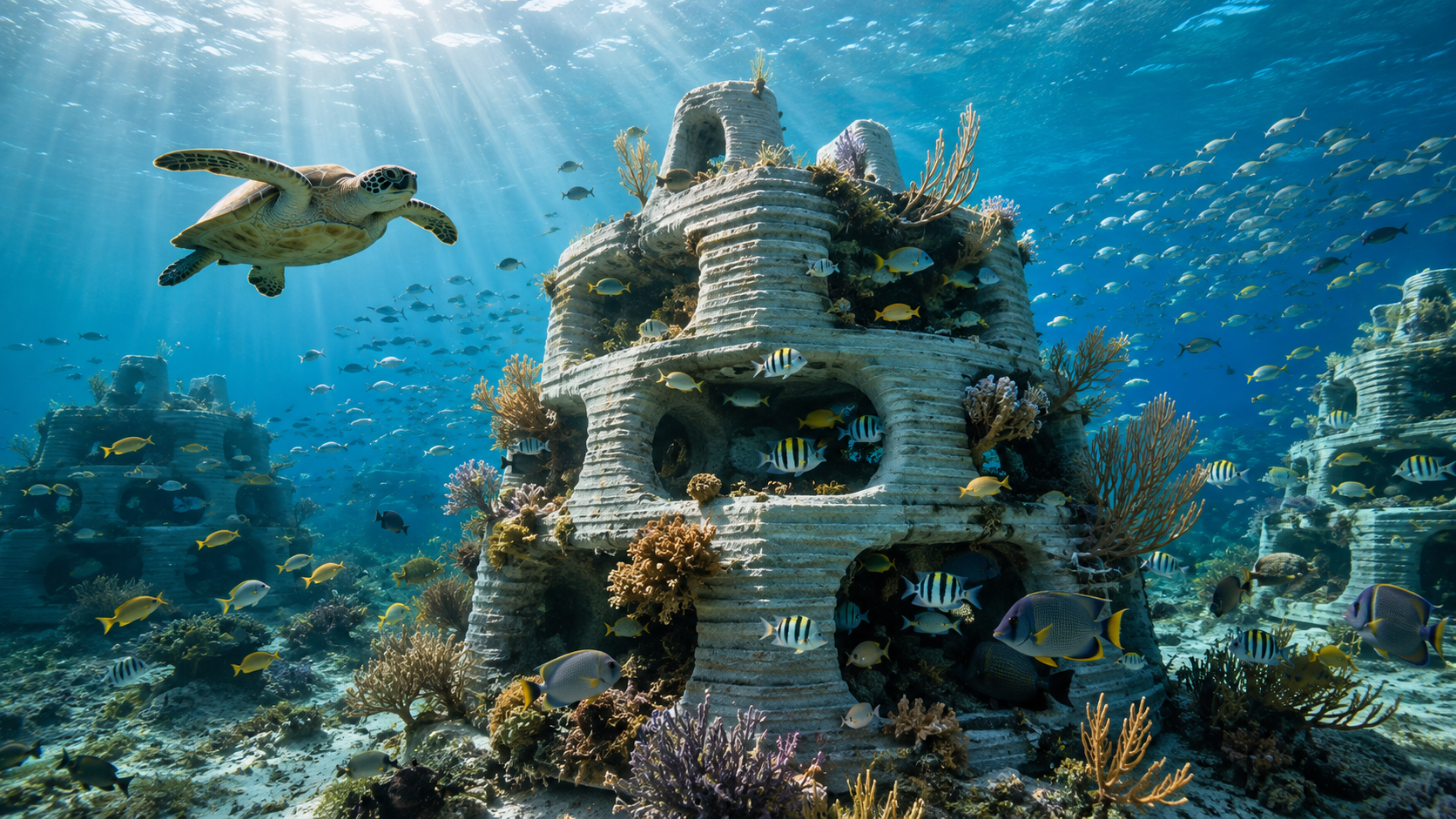
You can swim for half an hour off Miami Beach and see nothing but sand below. Flat, pale, featureless. Then you cross a shipwreck or a cluster of reef modules and the water turns into a city. Silver baitfish cloud the edges. Snapper hover in the shade of a steel hull. Sponges and corals paint the surfaces in orange and purple. Same water, same sand, radically different life.
That contrast is the entire story of artificial reefs, and South Florida has become one of the best places in the world to watch it play out. From Palm Beach down through the Florida Keys, people have been building underwater habitat for more than sixty years. Some of it worked beautifully. Some of it failed spectacularly. All of it teaches the same lesson: when you give the ocean a stable place to grow, marine life shows up fast.
What Is an Artificial Reef, Exactly?
An artificial reef is any hard, stable structure that people place on the seafloor to create habitat where little existed before. The word “artificial” makes some people wince, and that is fair. Nature did not ask for a sunken freighter. But the seafloor off South Florida is mostly sand, and sand supports very little. Hard surfaces support everything else: algae, barnacles, corals, sponges, oysters, and every fish that depends on them.
Think of it as real estate. A reef is a vertical structure rising from a flat plain, and in the ocean, vertical structure is scarce. That scarcity is what makes a single shipwreck so productive. Every ledge, every opening, every shaded corner becomes a home, and homes attract tenants.
The natural Florida Reef Tract, the only living barrier reef in the continental United States, runs from Martin County down through the Keys. It is the backbone of marine life here, and artificial reefs were never meant to replace it. They add hard structure where fish need it most: in nearshore waters where juvenile fish grow, where natural reef has been damaged, and along coastlines where development has erased the original habitat.
How South Florida Learned to Build Reefs, the Hard Way
Miami Dade County started one of the oldest county reef programs in the country back in the 1960s, deploying ships, concrete culverts, limestone boulders, and later reef balls, the domed concrete modules with holes that now sit on reefs around the world. Broward County built its own network of permitted sites. Palm Beach County gained one of its most popular wrecks by accident when the freighter Amaryllis grounded during Hurricane Betsy in 1965 and stayed.
But the early years also produced the cautionary tale every reef builder knows: Osborne Reef.
In the 1970s, an estimated two million tires were dumped off Fort Lauderdale to create a reef. Tires are cheap, but they are also light, round, and unstable. Storms moved them, and the tire field began smothering the natural habitat it was meant to supplement. Decades later, Broward County is still pulling tires off the seafloor, hundreds of thousands of them. The lesson was not that artificial reefs fail. The lesson is that materials, shape, and placement decide whether a reef builds habitat or destroys it.
Meanwhile, the region’s signature reef structures went to the bottom on purpose. In May 2002, the 510 foot tank landing ship Spiegel Grove was scuttled off Key Largo. It sank six hours early and rolled onto its side, then Hurricane Dennis pushed it upright in 2005. In May 2009, the 523 foot Vandenberg went down off Key West, one of the largest ships ever intentionally sunk for diving. Both were designed to do two jobs at once: create marine habitat and pull divers and anglers away from natural reefs that were already under stress.
What Artificial Reefs Actually Do for Marine Life
Ask what a reef structure actually does underwater, and the answer follows a sequence. Five things happen, each one building on the last. Here is how it works.
It All Starts with a Surface to Hold Onto
In the ocean, almost everything starts with a surface. Coral larvae drift until they find a clean, stable spot to attach. Sponges, tunicates, and oysters need the same. On a sandy seafloor, there is nothing to attach to. A reef module or ship hull changes that in a matter of weeks, as microscopic algae and bacteria form a film that attracts larger settlers. Within a year, barnacles and tube worms cover the structure. Within a few years, reef building corals and gorgonians move in.
This is why coral restoration projects in the Keys pair so naturally with artificial structure. Organizations like the Coral Restoration Foundation grow staghorn and elkhorn corals in offshore nurseries near Key Largo and outplant tens of thousands of them onto reef frameworks, including restored and artificial ones. NOAA’s Mission: Iconic Reefs program is scaling the same idea across seven sites in the Florida Keys. The structure comes first. The coral follows.
Young Fish Need Somewhere to Hide Before They Can Grow
Juvenile fish are vulnerable. They need small spaces where bigger fish cannot reach them, and they need food close by. Artificial reefs are packed with both. Snapper, grouper, grunts, and damselfish use the crevices of modules and the interior spaces of wrecks as nurseries and daytime refuges. At night, the same structure becomes a hunting ground.
Fisheries biologists call this the attraction versus production debate. Some researchers argue that artificial reefs simply move fish from natural reefs rather than create new ones. The honest answer is that both things happen. Well designed reefs with high structural complexity and good placement clearly add nursery habitat and support higher local fish biomass. Poorly designed ones can act as dinner bells, concentrating fish where they are easier to catch. The design and management decisions matter as much as the structure itself.
A Reef Is a Food Factory, Not Just a Hiding Place
A reef is not just shelter. It is a food factory. Filter feeders like sponges and barnacles convert plankton into tissue. Small grazers eat the algae that coat every surface. Baitfish eat the grazers, and predatory fish eat the baitfish. Throw in the shade and current breaks that big wrecks provide, and you have a complete food web standing where open water used to be.
Studies across Florida’s artificial reef networks have documented fish communities on constructed reefs that rival nearby natural reefs in biomass, often within just a few years of deployment. The reefs near shore also feed the larger system, because many of the fish that grow up on them eventually move offshore to the reef tract and beyond.
Stepping Stones Across a Broken Seafloor
Marine habitat in South Florida is broken into patches: the reef tract, seagrass beds in Biscayne Bay, mangrove shorelines, and the sand flats between them. Young fish travel between these patches as they grow, and the journey is dangerous when there is nothing to hide behind. Artificial reefs act as stepping stones, giving migrating fish places to rest, feed, and avoid predators along the way. A line of well placed modules can function like a wildlife corridor, linking habitats that would otherwise be isolated.
The Quiet Benefit: Giving Natural Reefs a Break
This is the quiet benefit that rarely makes the headlines. South Florida’s diving and fishing economy is enormous, and every boat anchor, every fin kick, and every line does a little damage. Sunken ships like the Spiegel Grove and the Vandenberg are so popular that they absorb a meaningful share of that activity. Divers who would otherwise crowd natural reefs head to the wrecks instead. When the alternative is a stressed natural reef, an artificial one becomes a form of protection, not competition.
The Same Idea Is Moving to the Shoreline
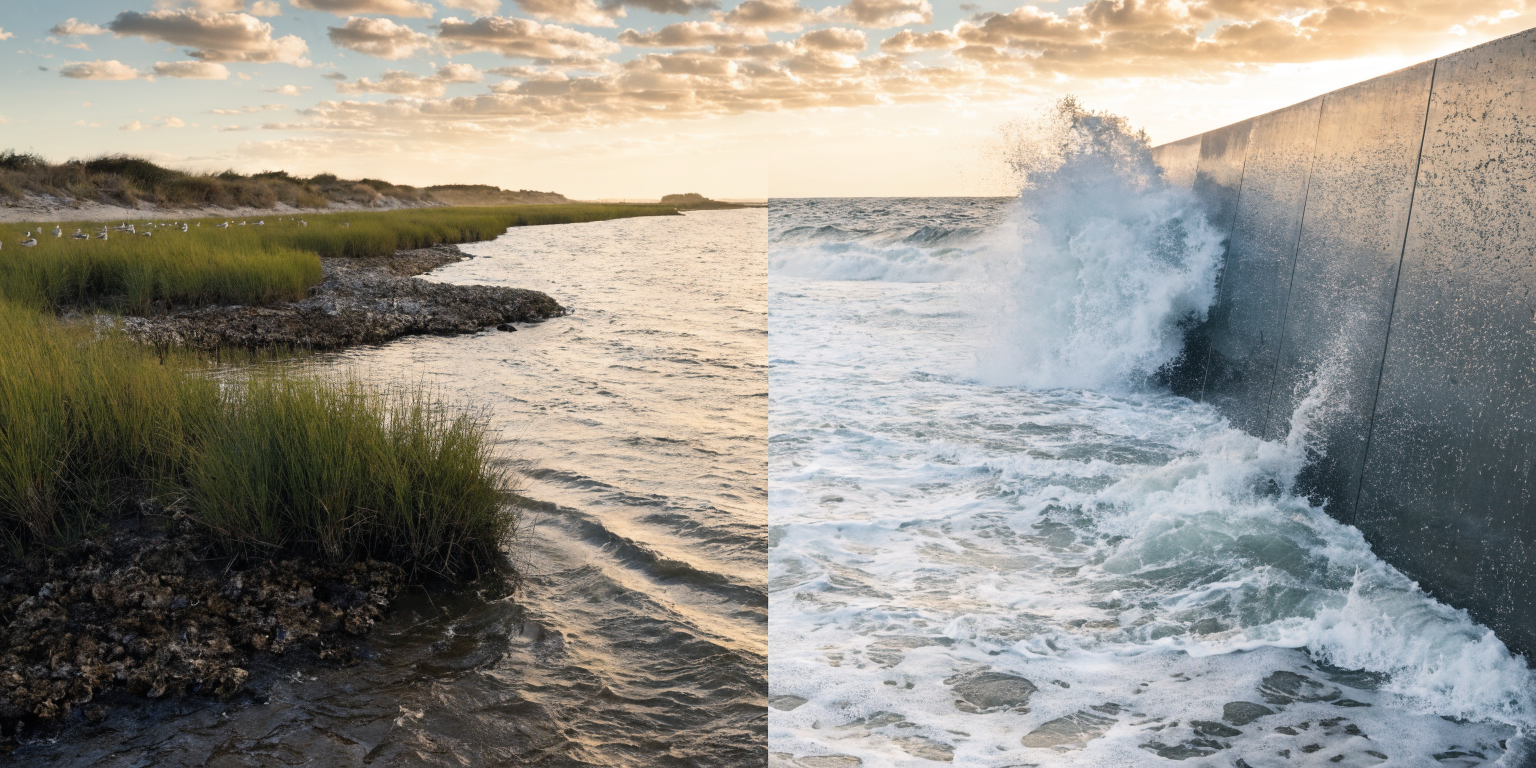
Here is where the story turns toward home. Most of the bayfront in Miami and Fort Lauderdale is lined with smooth concrete seawalls. They stop erosion, but they are ecological dead zones. Nothing grows on a flat wall, and the scour at its base destroys what little habitat remains.
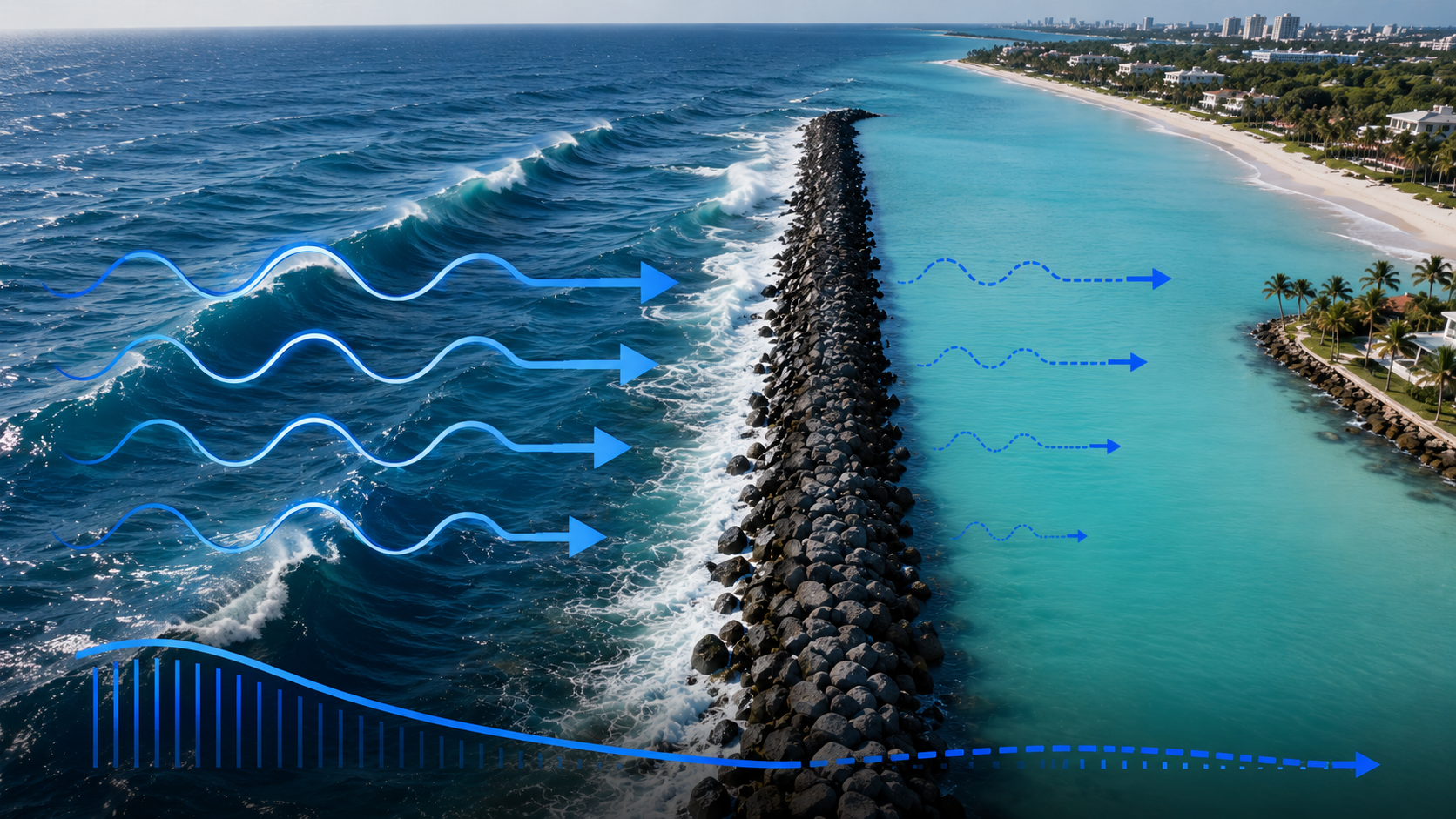
Texture changes that. Crevices and ledges multiply the surface area where larvae settle. They soften the flow that scours the wall’s base. And they shelter young organisms while they attach. The same rules that make a shipwreck productive apply to a seawall. Kind Designs, a Miami company, 3D prints living seawalls with that logic: panels as strong as precast concrete, textured to mimic natural rock. Oysters, barnacles, sponges, and algae settle on the surface. Mangroves root along the waterline. The wall still holds the shoreline. It also grows food, filters water, and shelters juvenile fish.
For property owners the value runs deeper. The wall still holds through storms, and the habitat it grows compounds over time. These systems can qualify for environmental mitigation, which changes the math of a permitting process. Each design is site specific, so planning covers water depth, exposure, and your existing structure first. If you have an aging seawall or a coastal project in the works, Kind Designs builds living seawalls across South Florida, and their cost calculator gives you a ballpark number in minutes. The same discipline that keeps offshore reefs working, stable materials, surface complexity, and honest monitoring, applies here. That is why the tire reef failed, and why Florida’s reef programs now require permits and follow up surveys.
What You Can Do Without Sinking a Ship
You do not need to sink a ship to help. Divers and anglers can report lionfish sightings, because invasive lionfish love artificial structure and eat the native fish that reefs are trying to grow. Volunteer programs with coral restoration groups in the Keys outplant corals on restored frameworks every year. Homeowners with failing seawalls can ask about living alternatives or Living Seawall Tiles before replacing concrete with more concrete. And anyone who loves South Florida water can simply support the county programs that permit, build, and monitor these reefs, because the science only works when someone keeps watching.
Questions People Ask About Artificial Reefs
Do artificial reefs actually work? Yes, when they are designed and placed well. They reliably increase habitat complexity and local marine life, often within months. The failures, like the Osborne Reef tires, came from treating the ocean as a disposal site instead of an ecosystem.
Do artificial reefs hurt natural reefs? Generally they help by drawing activity away from stressed natural reefs. They can cause harm when poorly sited or built from unstable materials, which is why permits and monitoring are non negotiable.
How long does it take for an artificial reef to grow? Algae and barnacles appear within weeks. Sponges and corals take a few years. A mature reef community with large fish populations can take a decade or more, which is why protecting these sites matters.
What are artificial reefs made of? Ships stripped of fuel and toxic materials, concrete modules like reef balls, limestone boulders, culverts, and engineered panels. The common thread is clean, stable, non toxic material with lots of surface area and hiding places.
Can I build my own artificial reef? Not without permits. In Florida, reef deployment requires approval from state and federal agencies, and unpermitted dumping is illegal for good reason. The tire reef is the proof of what happens without oversight.
The Bottom Line
Artificial reefs are not a replacement for the real thing. They are a bridge: a way to give the ocean back some of the structure that development and time have taken away. South Florida has spent sixty years learning how to build them well, from the wrecks of Key Largo and Key West to the modules off Miami and Fort Lauderdale, and now to the living seawalls along our own shorelines. Every one of them works on the same principle. Give marine life a stable place to hold on, and it will come.
If you are planning a coastal project in South Florida and want the wall on your shoreline to grow life instead of stopping it, the team at Kind Designs builds living seawalls and shoreline habitat systems for exactly that purpose. They can tell you what fits your site, your budget, and the water in front of your property. The ocean has been waiting for a better seawall. It is finally getting one.